GoHighLevel Migration Cost and Timeline: What Must Be Mapped, Tested and Handed Over
GoHighLevel migration cost depends on what must move, what must be rebuilt and how much testing is required before the old system can be retired. Contact count alone does not tell you the size of the project.
Here is where businesses usually get stuck: they plan the data import but forget the live process around the data.
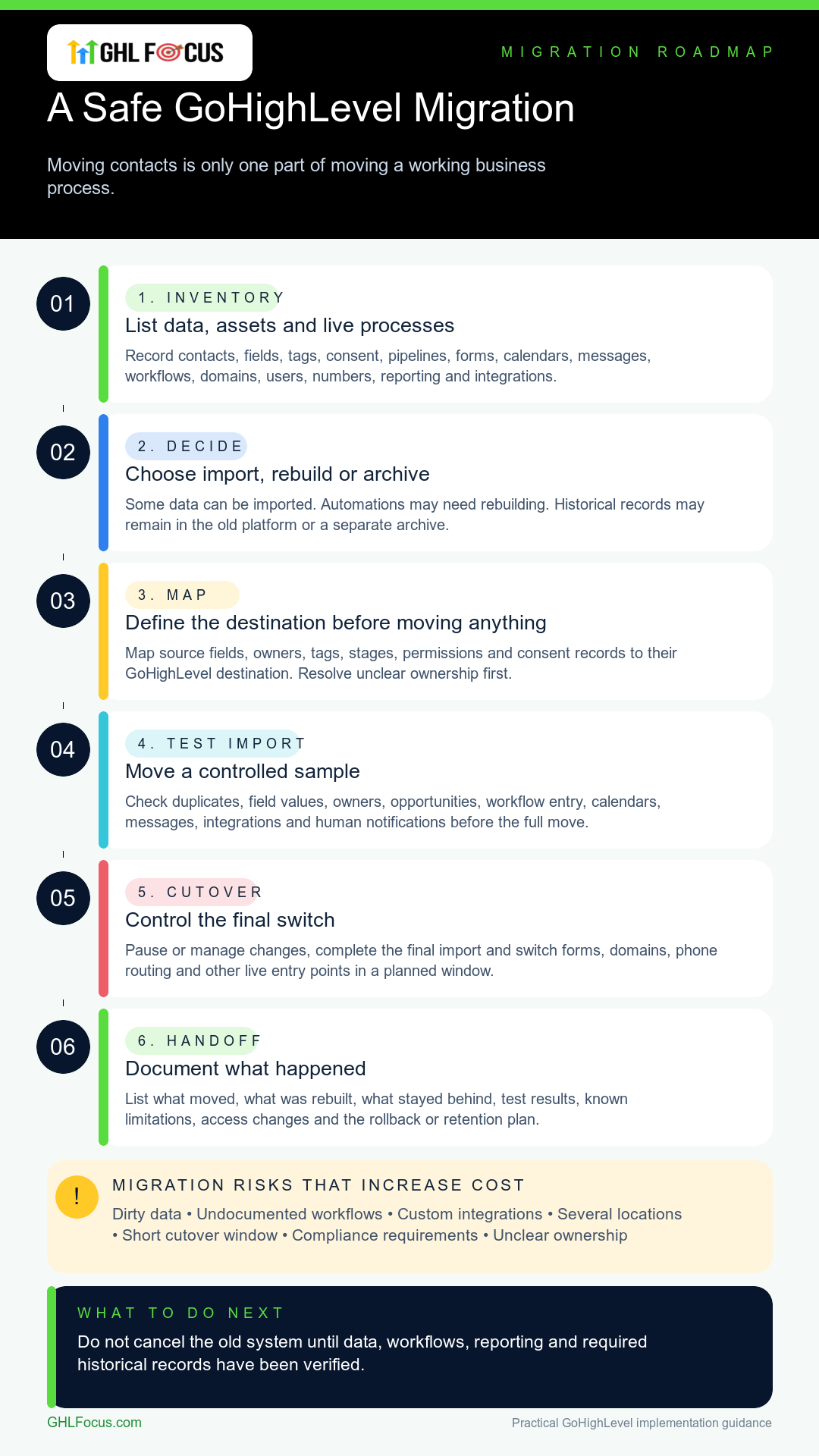
What are you actually migrating?
Start with an inventory. Depending on the current system, that may include:
- Contacts, custom fields, tags and consent records.
- Companies, opportunities, pipelines and stages.
- Forms, surveys, calendars and appointment settings.
- Email and SMS templates.
- Workflows, timing rules and stop conditions.
- Funnels, domains, tracking and integrations.
- Users, permissions, phone numbers and sending services.
Some items can be imported. Others must be rebuilt. Some historical data may need to remain in the old platform or a separate archive. Decide that before the move begins.
What increases GoHighLevel migration cost?
- Dirty, duplicated or inconsistent data.
- Unclear field, tag and pipeline mapping.
- Several business locations or brands.
- Complex workflows with no current documentation.
- Custom API, webhook or payment integrations.
- A short cutover window with little room for interruption.
- Compliance, consent or historical-record requirements.
A clean contact import may be straightforward. Recreating the logic behind sales, booking, fulfilment and reporting is a different project.
A practical migration timeline
- Discovery: inventory the current system, ownership and business-critical journeys.
- Mapping: decide where every field, stage, tag and action belongs in GoHighLevel.
- Build: configure the destination account and rebuild required automations.
- Test import: move a controlled sample and check records, ownership and workflow behaviour.
- Cutover: pause or control changes, complete the final move and switch live entry points.
- Handoff: document the result, limitations and old-system retention plan.
The exact timeline depends on the scope and how quickly decisions, access and clean data are provided. A deadline without a migration inventory is only a guess.
What should be tested?
Do not stop at “the contacts are visible.” Test:
- Field values, tags, owners and duplicate handling.
- Opportunity stages and reporting totals.
- Forms, calendars and new lead creation.
- Email, SMS and phone routing.
- Workflow entry, exit and reply conditions.
- Payments, integrations and human notifications.
What does the client need to provide?
You need an owner for decisions, access to both systems, clean exports, current process notes, approved copy, sending credentials and time for acceptance testing.
If nobody knows which workflows are still needed, begin with discovery rather than importing everything.
What should be included in the handoff?
The handoff should list what moved, what was rebuilt, what stayed behind, test results, ownership, access changes, known limitations and the rollback or retention plan.
GHLFocus provides a dedicated GoHighLevel migration service. If the migration scope is not clear yet, start with a consultation. New destination accounts may also need setup and onboarding.
Frequently asked questions
Can every workflow be copied into GoHighLevel?
Not always. The new platform may use different triggers, actions, data structures or integrations. Rebuild the business outcome instead of forcing an exact technical copy.
Should I cancel the old CRM immediately after migration?
No. Keep access until data, workflows, reporting and required historical records are verified. The retention period should be part of the migration plan.
Can you quote a migration from the contact count?
Contact count is one factor. Workflows, custom fields, pipelines, integrations, data quality, locations and testing usually affect the scope more.
A sample migration mapping sheet
The migration inventory should be a working control document, not a loose list of exports. Use one row for every field, status, asset or automation decision.
| Source item | GoHighLevel destination | Transformation or rule | Validation |
|---|---|---|---|
| Contact email | Standard Email field | Trim spaces, normalize case, reject invalid values | Sample count and invalid-record list |
| Lead status | Pipeline and opportunity stage | Approved source-to-stage mapping | Totals by source and destination stage |
| Marketing consent | DND and consent records | Preserve source, status and available timestamp; do not infer consent | Spot-check representative records |
| Owner | Assigned user | Map inactive users to an approved fallback owner | No orphaned high-priority records |
| Active automation | Rebuilt HighLevel workflow | Document trigger, branches, waits, stop conditions and handoff | Success, reply, booking and failure tests |
How GHLFocus scopes cost and timeline
GHLFocus does not publish one fixed migration price or duration because the source export, data quality, automation rebuild and cutover risk must be inspected first. A responsible quote should state:
- The systems and locations included.
- The record and asset inventory used for the estimate.
- What imports directly, what is rebuilt and what remains archived.
- Dependencies owned by the client, including domain, phone, email, payment and calendar credentials.
- The test-import date, acceptance window, final cutover and rollback decision.
- The price for the approved scope and the change process for newly discovered work.
A simple contact import with a clean schema can move quickly. A multi-location cutover with undocumented workflows, active integrations and strict downtime constraints is a different project. The inventory—not the contact count alone—controls the quote.
Concrete GHLFocus migration deliverables
The current GoHighLevel migration service includes a migration inventory, field and status map, approved data import, selected asset rebuild, test results and exceptions, and a documented cutover checklist. The service sequence is review, map, staged migration and testing, then cutover.
Acceptance evidence before the old system is retired
- Imported totals reconcile to the approved source export, with rejected records documented.
- Representative contacts preserve fields, consent, tags, owners and source context.
- Opportunity totals and stages reconcile to the agreed mapping.
- Forms, calendars and new lead creation work in the destination.
- Email, SMS, phone, workflow and staff-notification paths have been tested.
- Domains, payments, integrations and sending services have confirmed owners.
- The team has reviewed known limitations and the old-system retention or rollback plan.
Use this guide to evaluate your migration plan. We have not published a client-approved migration case with record totals, delivery time or business results. The mapping sheet and checks above show you what to ask for; your own inventory and test results should determine the migration scope and cutover date.
GHL Focus
Planning a move to GoHighLevel?
We can review the source system, map the real scope and build a migration plan before anything is switched off.